 EN


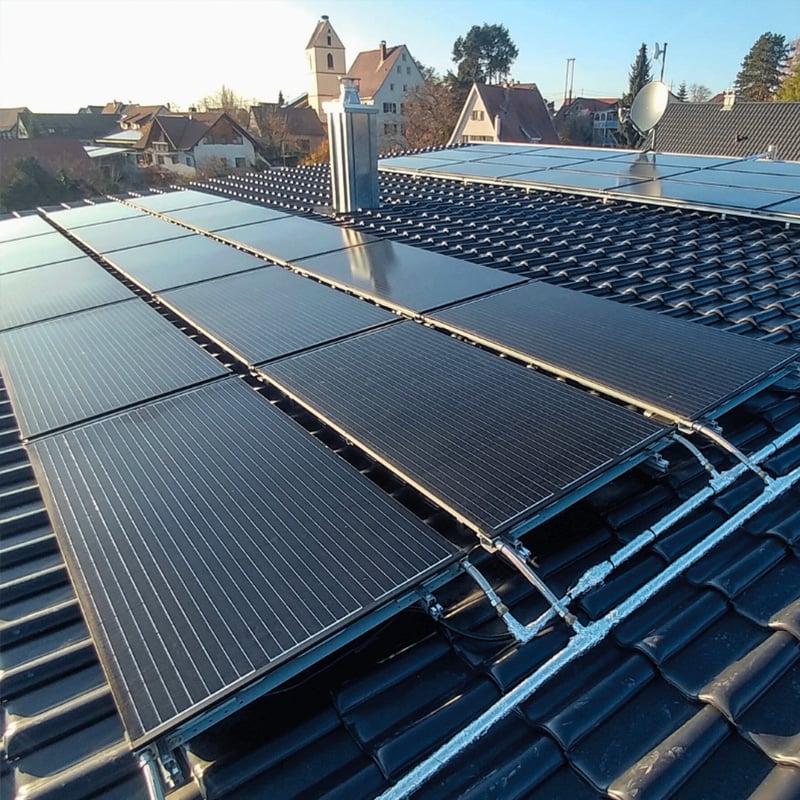
We have supplied PVT modules into Dutch, Polish and Austrian projects, and the questions we get in the first technical call are remarkably consistent. This article collects the fourteen that come up most often, with the numbers that answer them, so that a distributor or installer can evaluate a PVT offer without a week of email.
All figures below refer to the WindFull WF-PVT600 module unless stated otherwise.
Ordering and logistics
What is the minimum order, and how does it ship?
The module is packed 26 pieces per pallet, with two pallets forming one stack. Minimum order quantity, container loading plan and mixed-model consolidation are quoted per order — but the packing configuration is fixed at 26 per pallet, which is what your warehouse and your unloading equipment need to plan around.
One practical note: the module is 2,172 × 1,303 × 35 mm and weighs 29 kg. That is a two-person lift on a roof, and it is a wide module — check that your access route, scaffold gap and roof hatch can take a 1.3 m width before you order a container, not after.
What does the module weigh per square metre, and what roof load should I design for?
29 kg over 2.83 m² of gross area is about 10.2 kg/m² for the module alone. Add mounting rails, clamps and ballast and a realistic installed figure is 13–15 kg/m², comparable to a conventional framed PV module of the same generation. That is the dead load. Snow load and wind uplift are calculated separately to EN 1991-1-3 and EN 1991-1-4 for the specific site, and the roof structure — not the module — is usually the limiting element on retrofit projects.
Can I mix PVT and conventional PV modules on the same string?
No. The WF-PVT600 has its own electrical signature — Vmp 35.44 V, Imp 16.93 A, Voc 43.77 V, Isc 17.83 A — and any conventional module you pair it with will have different values. Modules on the same string must carry the same current, and modules on the same MPPT should have closely matched voltage characteristics. Use a separate MPPT input, or a separate inverter, for the PVT string. On mixed roofs we normally recommend a dedicated PVT inverter or a multi-MPPT hybrid inverter with the PVT array on its own tracker.
What is the lead time and the production capacity behind it?
Production capacity is in the order of 2,000 units per month across the range, with OEM/ODM available for power, voltage, frame colour and logo. For project quantities, confirm the slot at the time of order — PVT demand is seasonal and container space in Q1 and Q2 fills early.
Electrical design
How many modules can I put in a string?
The module is rated for 1,000 V or 1,500 V DC systems and has a temperature coefficient of Voc of −0.29 %/K. Voc rises as temperature falls, so the string length must be calculated at the lowest expected cell temperature, not at STC.
| Condition | Voc per module | Max modules, 1,000 V system | Max modules, 1,500 V system |
| STC (25 °C) | 43.77 V | 22 | 34 |
| −10 °C | 48.2 V | 20 | 31 |
| −20 °C | 49.5 V | 20 | 30 |
For a Central European site designed to −10 °C: 20 modules per string on a 1,000 V system, 31 on a 1,500 V system. For a Nordic site at −20 °C: 20 and 30 respectively. Always leave margin for the inverter's maximum input voltage tolerance and for the fact that the coldest hour and the highest irradiance rarely coincide — but design on the conservative number.
What about the current rating and fusing?
Isc is 17.83 A, so the 1.25 × Isc rule gives 22.3 A. The module's maximum series fuse rating is 30 A, which leaves headroom for standard string fusing and for the reverse-current contribution of parallel strings. With Imp at 16.93 A, check your inverter's per-MPPT current limit — a 20-module string is 12 kWp, so a 12 kW inverter on a single MPPT will need to accept close to 17 A.
Does the electrical output suffer because the module is also collecting heat?
The opposite. A PVT module runs cooler than a bare PV module because the hydraulic circuit removes heat from the back of the cells, and cell temperature is the main driver of the power temperature coefficient (−0.35 %/K for Pmax on this module). Measured annual uplift on PVT versus PV in comparable installations is typically in the range of a few percent — treat it as a bonus, not as the basis of the business case. The business case is the thermal output.
Thermal and hydraulic design
What flow rate does each module need?
Design flow for PVT is normally expressed per m² of aperture. The practical range is roughly 25–45 litres per hour per m², which for this 2.83 m² module means about 70–130 L/h, or 1.2–2.2 L/min per module. Ask for the rated flow and the pressure drop at that flow in the quotation — the pressure drop figure is what determines your pump, and it varies significantly between PVT designs.
What loop temperature should I run?
As low as the load allows. Thermal efficiency falls as the difference between collector temperature and ambient temperature rises, so a PVT array running at 30–40 °C delivers far more annual heat than the same array at 60 °C. This is why PVT pairs naturally with a heat pump or a preheat cylinder rather than with a high-temperature application.
How do I protect the loop from frost?
Propylene glycol at a concentration matched to the local design minimum temperature, typically 30–40 % for −15 to −20 °C. Three rules that protect the warranty: use inhibited propylene glycol intended for solar loops (not automotive antifreeze), confirm the maximum concentration and material compatibility with the supplier in writing, and check glycol pH and concentration annually. Neglected glycol is the single most common cause of failed PVT warranty claims, because degraded glycol becomes acidic and attacks the aluminium channel.
What happens to the heat in summer when nobody needs it?
This is the question that separates a working system from a nuisance. Options, in order of preference: dump the heat into a pool; use it for domestic hot water with a large cylinder; circulate at night to reject heat to the sky; or, on larger arrays, use a heat dump radiator. A PVT array with no summer sink will hit its high-temperature limit and shut down, which wastes the best production weeks of the year. Size the thermal side against the summer load and plan the sink at design stage.
Can PVT feed a heat pump directly?
Two architectures are possible. The straightforward one uses PVT heat to preheat a cylinder or buffer while the PVT electricity runs an air-source heat pump — this is what our integrated PVT and heat pump water systems do. The higher-efficiency option feeds PVT heat into the evaporator of a water-source heat pump through a plate heat exchanger, but that requires a water-source unit and a properly separated glycol circuit. An air-source monoblock cannot be used for the second arrangement. Decide which one the project is before specifying the array, because the flow rates and temperatures differ.
Commercial, warranty and support
What documentation comes with the order?
Module-level: IEC 61215 and IEC 61730 test reports, EU Declaration of Conformity, RoHS declaration, and the thermal performance test report including the efficiency curve. System-level: hydraulic schematic recommendations, string design support, and installation and operating manuals. If you are importing into the EU, also confirm the WEEE and packaging producer responsibility position before the first shipment — it is the obligation most first-time importers overlook.
What voids the warranty, and what does the warranty actually cover?
Ask this explicitly, and get the answer in the contract rather than in a brochure. Typical exclusions across the industry are: glycol neglect or use of non-approved fluid, operation above the rated maximum temperature or pressure, modification of the hydraulic circuit, mounting outside the approved load cases, and damage from hail or handling. A credible PVT warranty separates three things — product/workmanship, electrical power output, and thermal performance — and states the term for each. If the thermal performance term is missing, the warranty does not cover the part of the product that generates most of the value.
Two questions we wish buyers asked more often
"What is the thermal efficiency curve?" Not the peak efficiency, the curve. It is the only basis for predicting annual thermal yield and therefore the only basis for the payback calculation you will present to your customer.
"What is the pressure drop at design flow?" Because the pump is the component that quietly ruins under-designed PVT systems. A 10-module array that needs 1.5 m of extra head is a design change, and it is much cheaper to discover in the quotation than on the roof.
Table of Contents
- What is the minimum order, and how does it ship?
- What does the module weigh per square metre, and what roof load should I design for?
- Can I mix PVT and conventional PV modules on the same string?
- What is the lead time and the production capacity behind it?
- How many modules can I put in a string?
- What about the current rating and fusing?
- Does the electrical output suffer because the module is also collecting heat?
- What flow rate does each module need?
- What loop temperature should I run?
- How do I protect the loop from frost?
- What happens to the heat in summer when nobody needs it?
- Can PVT feed a heat pump directly?
- What documentation comes with the order?
- What voids the warranty, and what does the warranty actually cover?